Friday, February 13, 2009

The Cave of Wonders

We're trying to avoid doing laundry for as long as we possibly can, as we still haven't figured out how to work our washing machine (circa 1893). So, yesterday Jess, Caitlin and I decided to leave our humble abode for the evening to expand our wardrobes. Instead of trying our luck at dear old Khan al-Khalidi (the horrible tourist market, where we were hassled to no end) again, we went to the only place in Egypt where prices are fixed and unaffordable.
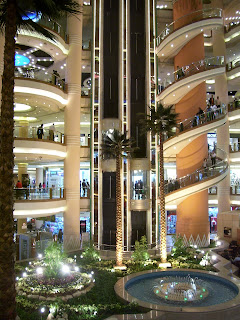
A setting oddly reminiscent of that which saw Augustus Gloop's tragic downfall

Yes my friends, Cairo has its very own luxury mega-mall. It's located between districts on the outskirts of al-Qahira, called Heliopolis and Nasr City, where wealthy Cairenes move to get away from the grime, noise and lower classes of the inner city.
Now, to my shame, I have been to the third largest mall in America, but it looks like a village marketplace compared to City Stars.

The Egyptian elite on escalators

Raised by a mother bred in post-war Germany, I have been trained in thrift to the extreme. I am therefore generally keen to avoid paying high prices for anything and have rejoiced at the affordability of life in Cairo. Confronted with American price tags in City Stars, I backed out of any store I entered, horrified.
What struck me as extraordinary, however, was the mass of Egyptians clutching Prada bags and wearing Omega watches, who dished out thousands of pounds in an evening without blinking an eye.


Perhaps it is naive of me to wonder where Egyptian wealth comes from. Every country has its upper class. I suppose I simply didn't expect it to be so very rich in Egypt, where bread costs a few cents and many live on less than $50 a month. There is no real middle class, it seems, and the rich hardly mix with the poor.

Tuesday, February 10, 2009

Don't get Kerried away with activism in Egypt

Protests for a Protester

A recent protest in Cairo, meant to raise awareness for the situation in Gaza, ended in the arrest of a German-Egyptian AUC student, Philip Rizk, by the Egyptian authorities. The latter seem to be reacting to increased pressure from internal critics of Egypt's Gaza policy. Among other things, vocal Egyptians are protesting the closing of the Rafah border, the only border between the Palestinian territories and a country other than Israel, which is therefore Gaza's only land passageway to outside aid.

AUC students have started a campaign demanding Philip's release from an undisclosed location. "Where is Philip Rizk?" signs read, displaying their authors' incisiveness. The New York Times published a short piece on the arrest yesterday.


My friend Kerry can be seen in a bright green "Guiness" shirt in the background. I'm not sure if he actually attended the protest and was looking intentionally grim, or if he just happened to be standing nearby and was quietly expressing his bewilderment over the goings on. (Just to clarify, the picture posted above was taken from the NYTimes piece. And for future reference, any good pictures posted here will in all likelihood not have been taken by myself.)

Monday, February 9, 2009

Roadside Bizarre

Outside of markets and regular shops, some Egyptians sell their goods by walking up to cars on busy roads. Women in full hijab yell "Madam, madam!" (I am often "ma'amed" in the States, and apparently even here people take me for a middle-aged, married woman) and try to sell me their vegetables. Young children press their faces against the windows of taxicabs, clutching wilted herbs. Old men in wheelchairs roll up to the driver's side and offer up tissues for sale. Though slightly irritating at times, these attempts at making a living seem remotely feasible.

I witness a much stranger enterprise on my way to school every morning: A pair of men standing in the middle of a busy highway, waving inflatable penguins at passing motorists. The articles in question come in a variety of sizes for all your household needs, and a small flock of them bobbles merrily to and fro on the cement median between opposing traffic lanes. 
Now, I ask myself, why, why would these grown men set out every day to try and sell inflatable penguins to other grown men and women? Did they win a lifetime supply through a sweepstakes, for which they simply have no room or use? Do they really think they have found a viable niche market in the Egyptian economy? Of course, perhaps they have, and I will be proven horribly wrong when they emerge as Egypt's next multimillionaires, but I doubt it.
And on that note, more on Egyptian wealth to come.

Saturday, February 7, 2009

I have class.

Here is the list of courses I'm taking.

-Intro to Colloquial Arabic
-Art and Architecture of Cairo (we go on a lot of field trips to Islamic monuments and buildings)
-Modern Movements in Islam (turns out you need a solid background in Islamic history and theology for this class, neither of which I possess)
-Israeli Politics and Society (taught by an Egyptian professor...)
-Mediterranean Legends (includes Greek, Mesopotamian, Ancient Egyptian and Roman mythology)

Since my commute is 2-3 hours a day, I worked very hard to have only four days of class a week, which limited my options, but so far I'm quite pleased with my schedule.

Thursday, February 5, 2009

Hello, my name is...

In Arabic, the word "ana" means "I" or "me." I knew this coming to Egypt. I did not, however, realize how hilarious the Egyptians would find this. When I was asked my name for the first time in the market I simply said, "Anna." The salesman smiled and nodded. Yes, he wanted to know my name. I repeated it, and he just nodded again, waiting for me to give him my name. "Ismi Anna," I said, which means "my name is Anna" (or "my name is me"). 
He laughed and said "ismuki..." ("your name is..."), expectantly. It went on like this for a while, until another shopkeeper nearby, who apparently knew some English, explained the situation. The first man began to cackle, pointed at me and, unable to contain his glee, broke out in raucous laughter. I have encountered similar situations on an almost daily basis since. 
Some Egyptians feel the need to educate me as to the meaning of my name, most just laugh after they figure it out. Our dear bawab (doorman) Yassin actually made me write it out before he believed me. Two baristas at our local coffee place assured me that "it's a beautiful name," which is also interesting.
Well, at least I don't suffer the fate of my friend Caitlin, whom most Egyptians refer to as Kevin.

Sunday, February 1, 2009

Bartering School Part I

Sorry for the hiatus. I haven't had internet access. 

Finding an apartment in Cairo mostly involves walking around aimlessly and sticking one's head into the doorways of random apartment buildings. One then has to find the bawab, or doorman and ask for a "sha'a" or apartment. Most of the time they'll say no. 
In our case, we were quickly picked up by a Simsar, or real-estate agent, who led us around Zamalek, the leafy island in the Nile. We fell in love with the second apartment we saw and wanted to sign for it right away, hoping to avoid an exhausting day of flat-hunting.
The owner, Ashraf, met us in the apartment's living room and shook hands with me and my flatmates, Jess from Univ. of Rochester and Caitlin from UMich.  
Ashraf embodies what I would imagine an Egyptian mafia boss to look like. His hair is slicked back and he wears shiny, shiny shoes that end in points. His cigarette bobs up and down between his lips as he runs wads of cash through his hands, counting the bills in record time. He uses his deep voice sparingly, clearly aware of its intimidating effect.
He offered us the place for more than we were willing to pay, saying he had previously made an agreement with three boys also studying at AUC for that price. We had to decline and left, crest-fallen. 
We spent the remainder of the day trudging from one dissatisfying place to another. We finally collapsed at GAD, our favorite downtown Egyptian diner, for dinner and sat in frustrated silence, considering our options.
Suddenly, I saw that I had a missed phone call. It was Ashraf. All troubles were forgotten instantaneously and we tried to come up with a bargaining plan. 
It turned out that the three boys had found the apartment too expensive and that he was now willing to give it to us for less (a likely story, as this logic not only didn't make sense, but he now claimed that they went to Cairo University, not AUC). We arranged a meeting for the next day, where we finally sealed the deal.
Lesson learned: never assume that the price given in Egypt is the actual price or that it cannot be bartered down. Sometimes leaving and showing no further interest can work in your favor.

My last few days have been spent settling into the new apartment, which has Nile-views from all three bedrooms and both balconies. It's light and airy and the bathrooms are comparatively clean. Of course, there are always hidden problems. The kitchen smells like there's a decomposing body under the sink (a thorough cleaning of the cabinets and walls has helped this somewhat), and showers are only sometimes warm and rarely hot. But I'm not complaining because living off-campus was the best decision I could have made. The students in the dorms are under strict surveillance, cannot have visits from members of the opposite sex and those on-campus have NOTHING to do, as they're in the middle of the desert.